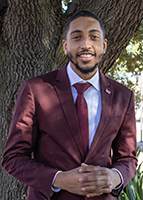
Wilson Community College proudly participates in the federally funded TRiO Upward Bound program, dedicated to empowering local youth in their pursuit of higher education. Through engaging instruction in literature, composition, mathematics, and science, students receive academic support on campus after school, on Saturdays, and during the summer—building the skills and confidence needed to succeed in college and beyond.
What is TRiO?
Our nation has asserted a commitment to providing educational opportunity for all Americans regardless of race, ethnic background or economic circumstance. In support of this commitment, Congress established a series of programs to help low-income Americans enter college, graduate and move on to participate more fully in America’s economic and social life. These programs are funded under Title IV of the Higher Education Act of 1965 and are referred to as the TRIO Programs (initially just three programs). While student financial aid programs help students overcome financial barriers to higher education, TRIO programs help students overcome class, social, and cultural barriers to higher education.
Programs at a Glance
Programs at a Glance
Students enrolled in today’s TRiO Programs mirror our nation’s multicultural and multiethnic society. Thirty-seven percent of TRiO students are White, 35% are African-American, 19% are Hispanic, 4% are Native American and 4% are Asian-American. Twenty-two thousand TRIO students are disabled.
TRiO college graduates are working in business, industry, government, medicine, law, education, communications, sales, finance, politics, transportation, publishing, law enforcement, computer science and technology, engineering, and accounting.
The TRiO Programs consist of Educational Opportunity Centers, Ronald E. McNair Postbaccalaureate Achievement, Student Support Services, Talent Search, Upward Bound, Upward Bound Math & Science, and Veterans Upward Bound. Wilson Community College has Upward Bound.
Evidence of Achievement
Evidence of Achievement
Students in the Upward Bound program are four times more likely to earn an undergraduate degree than those students from similar backgrounds who did not participate in TRIO; nearly 20 percent of all Black and Hispanic freshmen who entered college in 1981 received assistance through the TRIO Talent Search or EOC programs; students in the TRIO Student Support Services program are more than twice as likely to remain in college than those students from similar backgrounds who did not participate in the program.
Upward Bound
Program Description
Upward Bound provides fundamental support to participants in their preparation for college entrance. The program provides opportunities for participants to succeed in their pre-college performance and ultimately in their higher education pursuits. Upward Bound serves: high school students from low-income families; and high school students from families in which neither parent holds a bachelor’s degree. The goal of Upward Bound is to increase the rate at which participants complete secondary education and enroll in and graduate from institutions of postsecondary education.
Eligibility
Students must have completed the 8th grade, be between the ages of 13 and 19, and have a need for academic support in order to pursue a program of postsecondary education. All students must be either from low-income families or be potential first-generation college students. The program requires that two-thirds of the participants in a project must be both low-income and potential first-generation college students. The remaining one-third must be either low-income or potential first-generation college students. Students are selected based on recommendations from local educators, social workers, clergy, or other interested parties.